Showing posts with label Film Review. Show all posts

Friday, 5 February 2016

Sita sings the blues film review


Sita sings the blues (2008)

Sita sings the blues is the work of Jewish-American Nina Paley and has been heavily influenced by Indian mythology. Paley has animated the full feature length film with little help from others which in itself is an astonishing feat. 

Figure 1. Nina at the airport (2008)

Sita sings the blues is a mix of different styles which can be allocated to certain situations and time periods, but also changes depending on the music Paley has been using to tell the story. There are squiggly hand drawn frame by frame animations which take place in nowadays America or India, flash animations combines with songs from the 1920’s with Sita looking a lot like the Indian version of Betty Boop with bold round lines, solid colours, tiny waist with big hips and characteristically big round eyes, mirroring the art style of the 20’s. 

 Figure 2. Sita 1920’s (2008) 

Other art styles in Sita sings the blues are traditionally looking Indian deities in silhouettes, comparable to Lotte Reinigers animations, with the deities discussing the plot and explaining what happens to Sita, and, to some degree, what’s happening with Nina in the modern times. Emotions were also attributed their own style, as both love and loss are a big topic of the film, they are being expressed with irrational sparks and fireworks with characters emerging from behind them, goddess like. Collages are being used for the Indian songs with mismatched images.

 Figure 3. Narrator (2008) 

The narrative of in Sita sings the blues is not necessarily a 100% true to the myths, as some important details have been left out, for example the man who kidnapped Sita seems to be her father in Indian mythology, but there is no mention of that in the film.
The use of songs is very predominant and shows the narrative almost like a musical, while the mix of two particular styles of music is very interesting, as the music has been deliberately chosen from two different countries and ages, they’re being used as a stylistic method with matching animations. 

Figure 4. Emotions (2008)

The story is a mix up of the old Indian mythology combined with a modern love story, as the American main character (who coincidentally is called Nina) seems to identify with Sita, an Indian woman from mythology. Similar events are happening to both of them highlighting the parallels between them both: as Sita’s husband is banished from his own country, Nina’s boyfriend moves to India for work-related reasons, Sita goes through her trial of fire while Nina flies to India but is rejected by her boyfriend on several occasions, and finally Sita is swallowed by mother earth for being pure when Nina gets dumped, Nina’s feelings are being portrayed in a similar fashion to Sita going through her trial by fire, both emerging stronger at the other end.

Sita sings the blues is a powerful film that artfully combines many topics and styles and feels deeply personal, not necessarily made for an audience but for Paley herself, from herself.This film is hard to rate as there are no comparable one-person-feature-length animations out there, but she has done a splendid job with capturing a sense of deep emotional connection to both the main characters and combining the art styles to tell a story, rather than a collection of scenes, somehow, everything fits together. Definitely worth watching!

Illustration List:
Figure 1: Paley, Nina (2008) Nina at the airport [film still] available from: http://ep.yimg.com/ca/I/yhst-20024741711964_2257_9914838 (accessed: 5/2/16)
Figure 2: Paley, Nina (2008) Sita 1920s [film poster] available from: https://maaretta.files.wordpress.com/2011/06/ninadaveairport.jpg (accessed: 5/2/16)
Figure 3: Paley, Nina (2008) Narrator [film still] available from: http://sitasingstheblues.com/SitaEPressKit/BhavanaSitaContaminated.jpg (accessed: 5/2/16)
Figure 4: Paley, Nina (2008) Emotions [film still] available from: https://i.ytimg.com/vi/DyXCQ9kFTU8/hqdefault.jpg (accessed: 5/2/16)

Paprika Film Review


Paprika (2006)


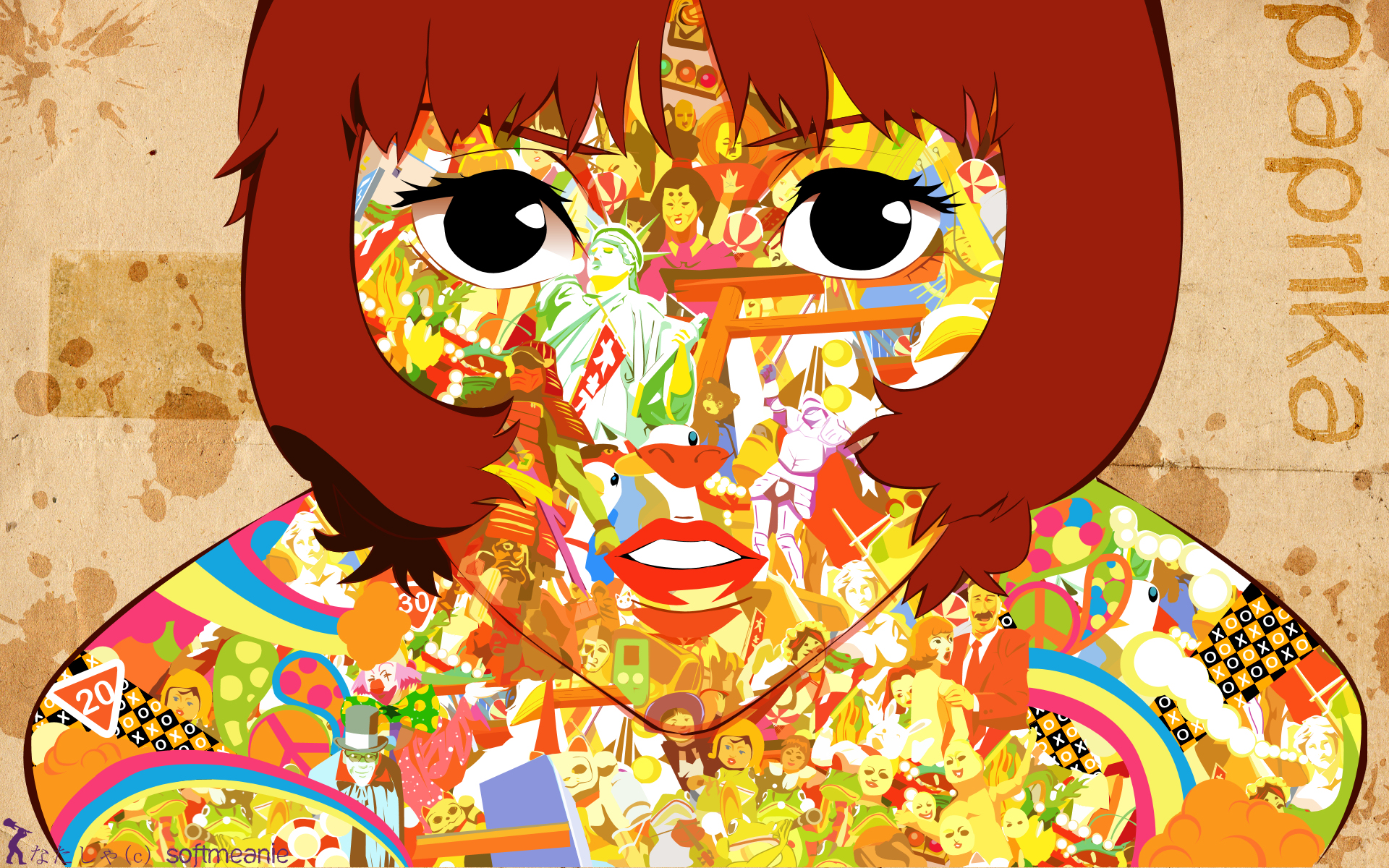
Directed by the late Satoshi Kon, Paprika is a Japanese animated feature length film in which the border between reality and dream loses definition. It is animated in the classical 2D style and makes use of vivid imagination and, unlike most other anime or animations, doesn’t aim to stay within the bounds of reality but warps and transforms in front of the viewers’ eyes, making the unthinkable possible. 

 Figure 1. Paprika (2006)

A device that allows for a person to enter someone else’s dream has been stolen, and the inventor team is on their feet to retrieve it again, with a seemingly stereotypical lady in grey office clothes, a brilliant genius inside an obese body and a little old man who loves his dog dearly. Over the length of the film, the characters develop away from those stereotypes and reveal their secrets, for example Chiba, the lady, has a dream alter ego called Paprika, who is visible on shiny surfaces and takes over in dreams.
The world is very grey and dominated by a city scape with little green for most of it, but the dream worlds are held on many colours, a circus for example, and a parade, but also a bar which is accessible over the internet (a dream you can walk into over the internet? Yes!) all have very red themes which stand out from the “real” reality. As is Paprika with her brown/red hair and red t-shirt, to maximise the contrast in personality to Chiba. 


Figure 2. Chiba (2006)

The animations are stunning, as while dreaming it is entirely possible that the whole world just starts wobbling and throws you off its edge, or if you are stuck in a situation it’s fine to jump into the nearest painting and borrow the racing horse. Paprika is a film that delivers on the potential that animation promises, instead of sticking to the “rules” which is very refreshing, and makes the viewer wonder how the other films by Satoshi Kon are, reviews online are promising. The whole world is stretchy – bendy and is being pushed to its boundaries (and probably beyond) all while the protagonists are trying to save their dreaming – devices. The story has a very Japanese touch to it and viewers with experience and understanding of the Japanese culture will find it easier to follow than those who haven’t, as certain elements are common knowledge in the east but do not make any sense to the west. For example, Paprika is in need of flying skills in a dream, so at her first convenience she “turns” into a fairy with little wings which can carry her to her desired location. Turning in this case means that there was a shelf of dolls and she turned into one of them – pushing reality in a dream. These things will obviously be seen as impossible by a broad audience, but considering it’s a dream anything can happen.
Paprika has been an inspiration for the film Inception, which also deals with different levels of dreams and how real reality really is. To both films applies that getting injured in a dream results in injury in the real world, and in both the question is asked “how do we know that this is reality and not just another dream?” Also, both feature an elevator which stops at certain dreams, but in Paprika fluidity between dreams and less science is the driving factor, while Inception has clear cut of points between the dreams to be able to distinguish them easier. 

 Figure 3. Warped Dream (2006) 

The most annoying detail about Paprika was the voice cast for me, the females were cast in unnervingly high squeaky frequencies which I find tolerable in Japanese but not in English and also the incorrect use of titles (it’s just Chairman, not Mr Chairman) but the soundtrack was really good.
Unfortunately, Paprika’s director Kon died in 2010 of pancreatic cancer so won’t be bringing out any more films, which is especially sad as there are very few good feature length anime, as most stories adapted from manga either end up as a series or get turned into a bad film, like X/1999 (or both).
Altogether, Paprika is a great film that needs watching more than once and possibly some delving into Japanese culture to understand the story fully. Also in regard to the American voice cast, subtitles might not be a bad idea, depending on taste. It is a stunningly visual piece with great animations and good character development, with enough back story for all of the main characters to make sense without losing its fantastic approach to storytelling. I very much enjoyed watching it and probably will again, along with Satoshi Kon’s other works. 10/10

Illustration List:

Figure 1: Kon, Satoshi. (2006) Paprika [movie poster] available from: http://static.zerochan.net/Paprika.%28Character%29.full.410935.jpg (accessed: 5/2/16)
Figure 2: Kon, Satoshi. (2006) Chiba [movie still] available from:  http://static.zerochan.net/Paprika.%28Character%29.full.410935.jpg (accessed: 5/2/16)
Figure 3: Kon, Satoshi. (2006) Warped Dream [movie still] available from:  http://moviesmedia.ign.com/movies/image/article/791/791727/paprika-20070524044625267.jpg (accessed: 5/2/16)

Friday, 15 January 2016

Mary and Max Film Review


Mary and Max Film Review  


 Mary and Max, produced by Adam Elliot and released in 2009, is a Claymation feature length film from Australia with a style distinct to Elliot. The cutesy style of the clay characters is deceiving as, even though the protagonist Mary starts the story at 8 years, it’s not a children’s animation at all as there are plenty of dark topics like alcoholism, mental health, obesity and trying to deal with loneliness. It starts off with the narrator’s voice who stays for the whole film, leaving little direct speech but adding to the charm as Mary is being introduced as a girl with glasses, a big nose and a mud-coloured mark on her forehead, with a kleptomaniac alcoholic mother who has to sample sherry all the time and a dad who strings tea bags together.

 One day in the post office, she finds an address book for New York, America and decides to write a letter to Max, a random name she found in the book. Max receives the letter and after a severe panic attack, he manages to write back and a pen-friendship flowers into being, both Mary and Max sharing an immense love for chocolate, having no friends except for animals and families that don’t function as well as they should. They exchange advice and answer the other’s questions like “where do babies come from? In Australia they come from beer”. Max, being socially reclusive despite being in his mid-forties and living in New York, makes Mary wonder about his diagnosis with Asperger’s, depression and obesity while the audience wonders how someone can identify as a Jew and an atheist at the same time – surely one must come after the other? Growing up, Mary has to deal with her father dying of a tragic accident soon after retirement and a mother who chooses drink over her daughter and accidentally reaches for the bottle of formaldehyde instead of sherry – leaving Mary orphaned and alone from a young age, now sharing that trait with Max. Mary marries her child hood crush and all is well, as he has a pen pal too and is very accepting of their relationship.
Figure 1. Mary (2009)

 Mary and Max uses strong stylistic elements and colours throughout the animation, as for example Mary’s world is in varying colours possibly describing her mental state (tinted pastel pink when happy and darker, nearly colourless when sad) while Max’s world is thoroughly in black and white, except for the items he receives from Mary, like the red pompom which he puts on top of his kippah.
The whole story is riddled with tragic accidents but also a certain type of hopefulness, and with the feeling of almost reaching, almost being there, in a happier place but narrowly missing, but nonetheless not giving up hope fully. It is a complex film with complicated themes that might be able to teach children a lot about tolerance, bullying, making friends and mental health but it is not lighthearted and should not be seen as easy entertainment but discussed with the family.

Figure 2. Max (2009)
 Mary and Max is immensely uplifting as the film has a very cute way of dealing with bullies – when Mary is told by a classmate that she has poo on her forehead Max advises her that it is chocolate coloured and that – when she arrives in heaven, she will be in charge of all the free chocolate and give it to everyone but her classmate which gives a young girl power over something she only ever thought negatively about. Mary also has eyes the colour of muddy puddles, and as about 90% of the world population have brown eyes I’m sure many people can identify with that phrase and take strength from it, where Mary once only saw weakness.

 Mary and Max is Adam Elliot’s only feature length animation as he prefers to do shorts, but after winning an award for his short story “Harvie Krumpet”, he decided to try himself on feature length and admits in an interview that if he would have known how much more it takes to make a full long animation he would have never done it (Pond, 2009). Elliot also admits that the animation is more a documentation of his own life and deals with many topics he had to deal in his childhood and when growing up, as he has a pen pal in New York who is Jewish, overweight and has Asperger’s.

Altogether, Mary and Max is a very powerful film with strong emotions that translate well from the screen into the viewer’s heads. It deals with adult themes but isn’t overshadowed with hopelessness and cynicism, as too many adult films are. The overall message seems to be a positive one, no matter what life throws at you. It is an excellent blend of styles with music and voice overs and truly heartfelt.

10/10


Illustration List:

Figure 1: Elliot, A. (2009) Mary [still of Mary and Max] available from: https://blogger.googleusercontent.com/img/b/R29vZ2xl/AVvXsEgXfqi1Lc4-240BBF8xdGGRIATcn_f7dknV8LDlPOGaQj0yI91pR7vNZKXtjOtz6Tlcnx5bQ9vM9DkQoPY8Rw61DMeD3GGbNuHVBUOMwGRKjJZHOO5H98lAQZeW8Er519onVkOQHqIsbyF9/s1600/Mary+and+Max+HQ+Wallpaper.png (accessed: 5/2/16)
Figure 2: Elliot, A. (2009) Max [still of Mary and Max] available from: http://nickyarborough.com/wp-content/uploads/2015/01/mary-max.jpg (accessed: 5/2/16)


Bibliography:

Pond, Steve. 2009 available from: http://www.thewrap.com/weird-brilliance-mary-and-max-11544/ (accessed: 15/01/16)